> ## Documentation Index
> Fetch the complete documentation index at: https://docs.dovetail.com/llms.txt
> Use this file to discover all available pages before exploring further.
# Channel context
> Set focus areas and link workspace docs so Dovetail's AI classifies feedback around what your team actually cares about.
## Adding context to your Channel
Context helps Channels generate better ideas, summaries, and responses by telling the AI what to focus on and what you already know about your business.
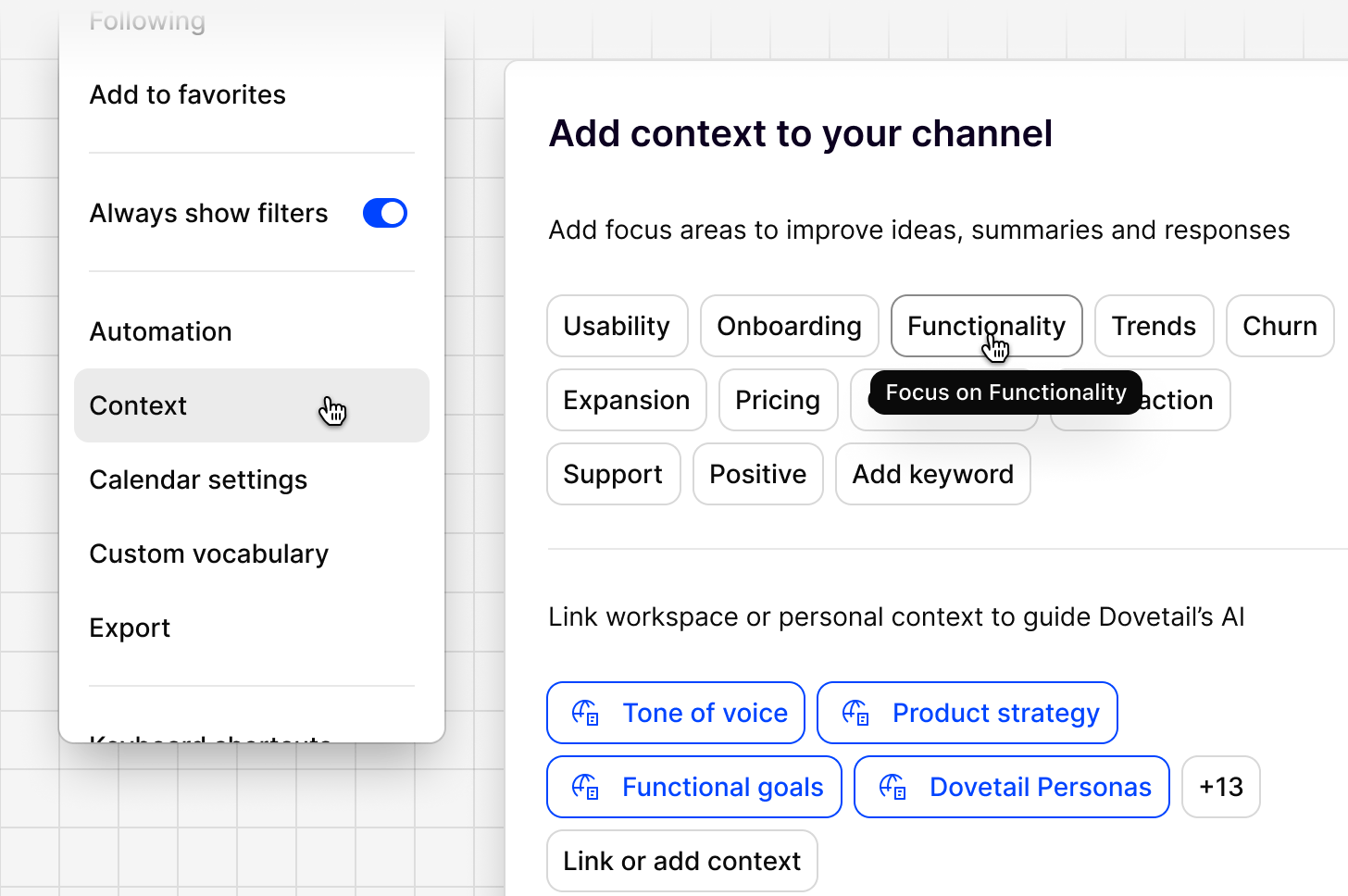
You will be prompted to set the Channel context during onboarding but this can be changed at any time. To do so, all you need to do is:
1. Click the `...` menu in the top right corner of the Channel
2. Select `Context` to configure two sections:
3. **Focus areas.** Select from suggested keywords such as `Usability`, `Onboarding`, `Functionality`, `Trends`, `Churn`, `Expansion`, `Competitors`, `Satisfaction`, and `Support`, or add your own with `Add keyword`
4. **Linked context docs.** Link a workspace or personal doc, such as a strategy doc or tone of voice guide, to guide how Dovetail’s AI interprets and writes about your feedback. Docs already in your workspace are suggested automatically, or use `Link or add context` to attach something new.
5. Click `Save` to apply your changes.
You can update focus areas and linked docs at any time, enabling your ideas to be dynamic based on business priorities. Changes apply going forward and don’t retroactively reclassify existing ideas.
The more specific your keywords and context, the more relevant your ideas. You can update both at any time from channel settings.
 ***
***
## Writing good context
When adding context to any channel, follow these core principles:
* Focus on 2-3 main goals that apply across all your data
* Keep it under 400 characters and be concise
* Use natural language with clear structure that helps you understand the content in a glance
* Avoid overly detailed specifics to prevent filtering out other valid insights
* Specify your role to direct AI to analyze data from your perspective
*Example: I am a Product Manager interested in feedback related to product intuitiveness in these product reviews. Highlight points where users felt confused, lost, or unsure how to proceed. Include any suggestions for improving clarity, flow, or ease of use.*
If multiple teams will be utilizing the channel, your context should balance diverse perspectives while maintaining focus. Key Elements to include for this use case:
* Identifies all participating teams
* States shared objectives
* Uses neutral language that serves all teams
* Focuses on outcomes relevant to everyone
*Example: This channel serves Product, Design, and Customer Success teams tracking product usability across reviews. Focus on: confusion points in user workflows, feature clarity issues, and actionable improvement suggestions. Highlight patterns affecting user experience and adoption.*
### Context strategies to consider
1. **Umbrella Approach:** Create broad context that encompasses all team needs:
* Use company-wide objectives as the foundation
* Focus on customer experience or business outcomes
* Avoid team-specific jargon or priorities
* Emphasize shared metrics and goals
2. **Perspective Integration:** Explicitly acknowledge different viewpoints
3. **Outcome-focused context:** Center on business results rather than team functions
4. **Journey-based context:** Organize around customer journey stages
***
***
***
## Writing good context
When adding context to any channel, follow these core principles:
* Focus on 2-3 main goals that apply across all your data
* Keep it under 400 characters and be concise
* Use natural language with clear structure that helps you understand the content in a glance
* Avoid overly detailed specifics to prevent filtering out other valid insights
* Specify your role to direct AI to analyze data from your perspective
*Example: I am a Product Manager interested in feedback related to product intuitiveness in these product reviews. Highlight points where users felt confused, lost, or unsure how to proceed. Include any suggestions for improving clarity, flow, or ease of use.*
If multiple teams will be utilizing the channel, your context should balance diverse perspectives while maintaining focus. Key Elements to include for this use case:
* Identifies all participating teams
* States shared objectives
* Uses neutral language that serves all teams
* Focuses on outcomes relevant to everyone
*Example: This channel serves Product, Design, and Customer Success teams tracking product usability across reviews. Focus on: confusion points in user workflows, feature clarity issues, and actionable improvement suggestions. Highlight patterns affecting user experience and adoption.*
### Context strategies to consider
1. **Umbrella Approach:** Create broad context that encompasses all team needs:
* Use company-wide objectives as the foundation
* Focus on customer experience or business outcomes
* Avoid team-specific jargon or priorities
* Emphasize shared metrics and goals
2. **Perspective Integration:** Explicitly acknowledge different viewpoints
3. **Outcome-focused context:** Center on business results rather than team functions
4. **Journey-based context:** Organize around customer journey stages
***