

Get started
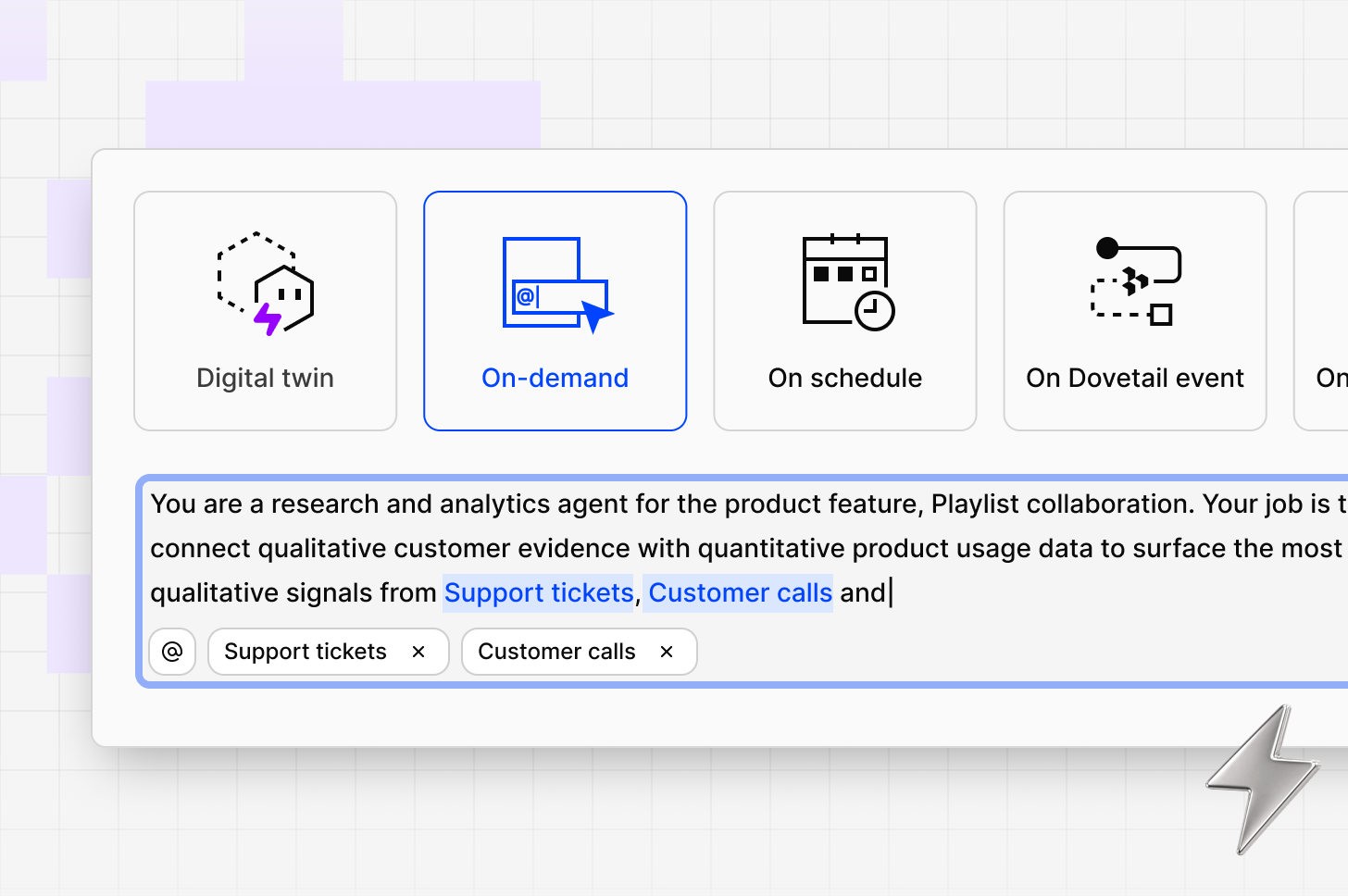
- Open Agents from your sidebar and select Create agent or prompt chat to help you create
- Set an agent type: Digital Twin, on-demand, scheduled, Dovetail event, external webhook.
- Give the agent a name and write its instructions. Add a persona if you want to shape its tone. Save the configuration.
- Attach skills—any doc that gives the agent useful context or a template to follow.
- Enable external connectors if the agent needs to reach outside Dovetail.
- Review Dovetail tools and disable any the agent doesn’t need.
- If required, click run now to trigger the agent and commence the configuration and flow.
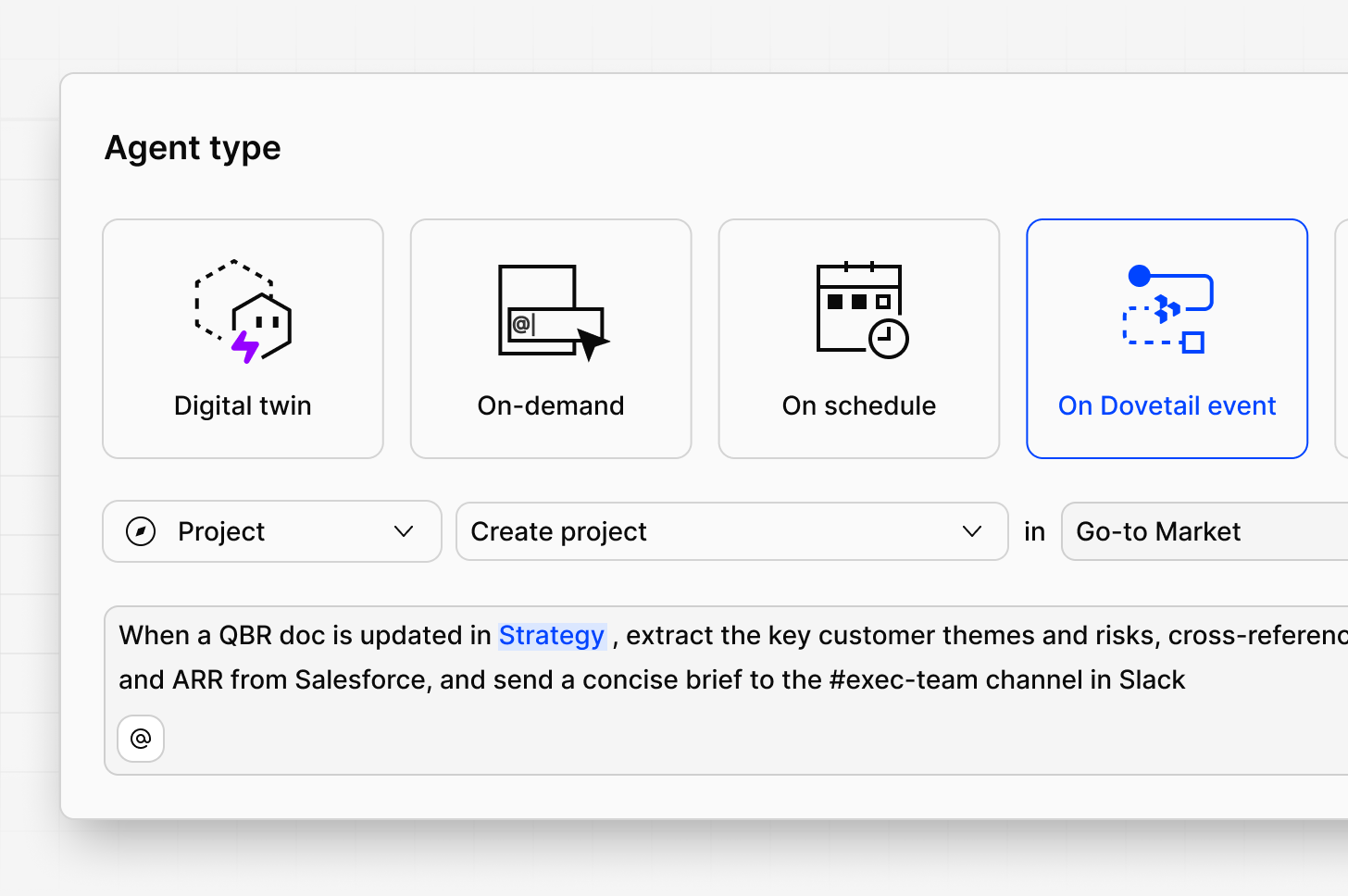
Triggers
A trigger defines when your agent runs. Choose the mode that fits how the work actually happens.Instructions
Instructions are the prompt that shapes how your agent behaves and what it produces. Write them in plain language, Focus on outcomes rather than steps. Describe what a good result looks like — not every action the agent should take to get there. Add an optional persona to shape tone and style — for example, “Concise analyst” or “Friendly researcher.” It’s a short phrase that gets added to the agent’s system prompt. It doesn’t change what the agent does, only how it communicates. Example:Every Monday, summarize new data added to the Support channel over the past week. Group findings by theme, lead with the most urgent issue, and include a direct quote for each theme.
Skills
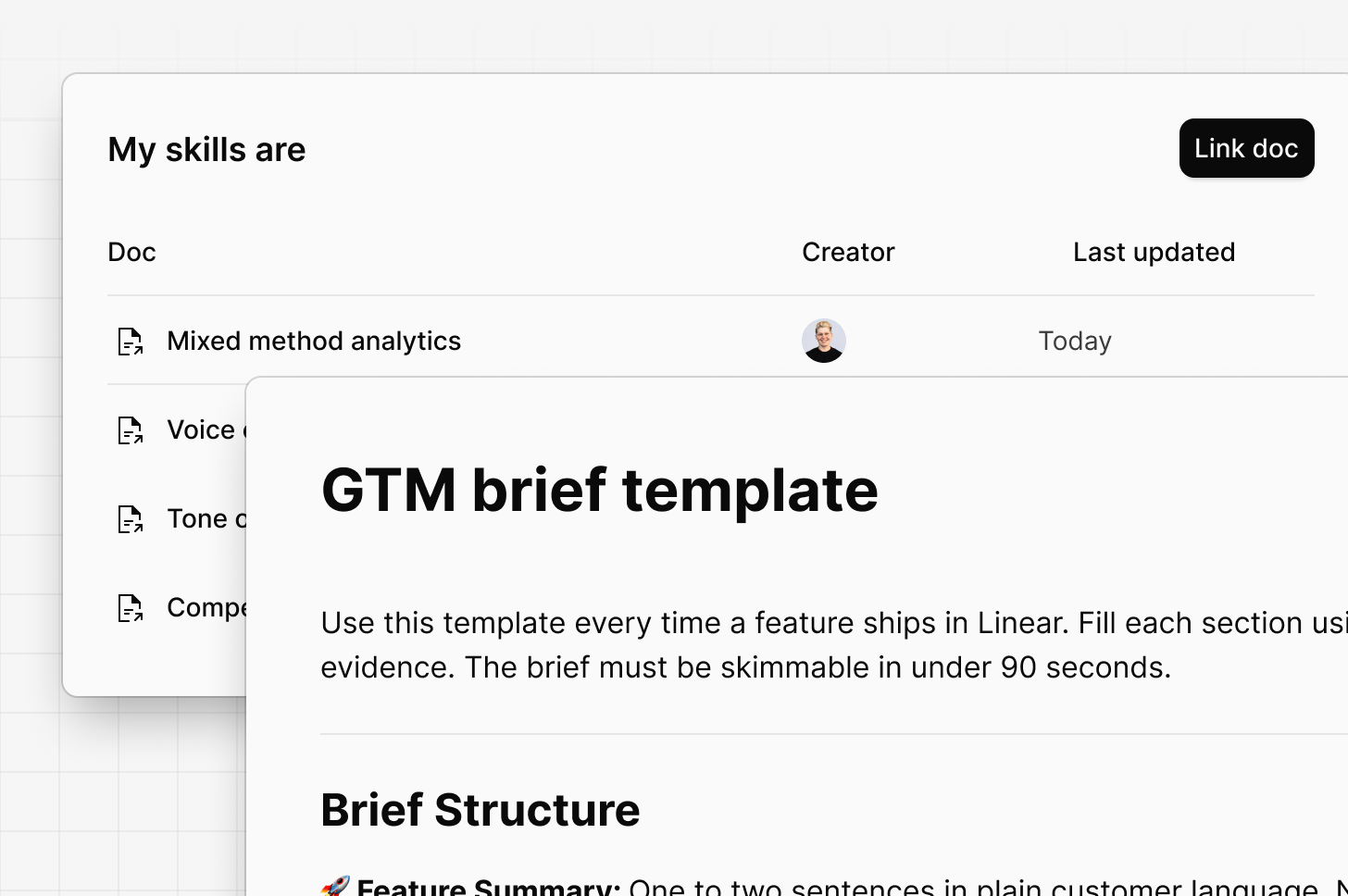
Skills are Dovetail docs you attach to an agent to give it knowledge it can’t derive from instructions alone. When the agent runs, the full content of each linked skill is injected into its context. How teams use this:- Templates—a standard format the agent should follow when writing summaries or reports
- Reference data—a tag taxonomy, list of product areas, or internal glossary
- Examples—sample outputs that show the quality and style you expect
- Background context—information about your product, team, or a specific initiative the agent needs to understand
- Tone of voice––Give your agent specific instructions on how speak, engage with you when invoked and style for outputs it creates
Dovetail tools
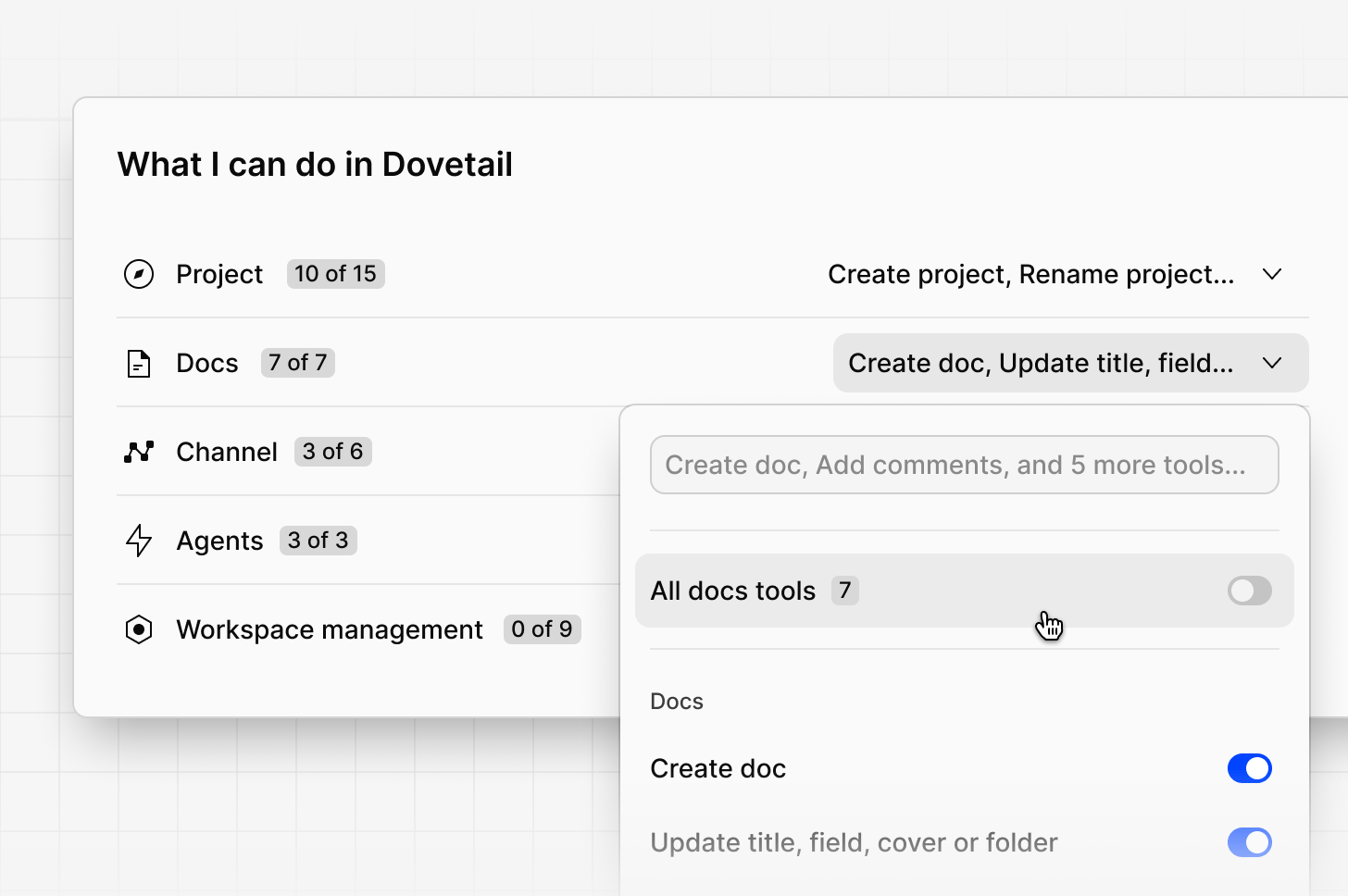
Dovetail tools are the actions an agent can perform inside your workspace. All tools are enabled by default — you can disable individual tools or entire categories to limit what any given agent can do.
Scope tools to what the agent actually needs. If an agent only creates docs, disable project and channel tools so it can’t make broader workspace. The less tools an agent has to choose from, the more accurate it’s execution.
External MCP connectors
External connectors give agents access to tools outside Dovetail using the Model Context Protocol (MCP). Once a service is connected, an agent can read from and write to it during a run or when invoked in chat.Supported connectors
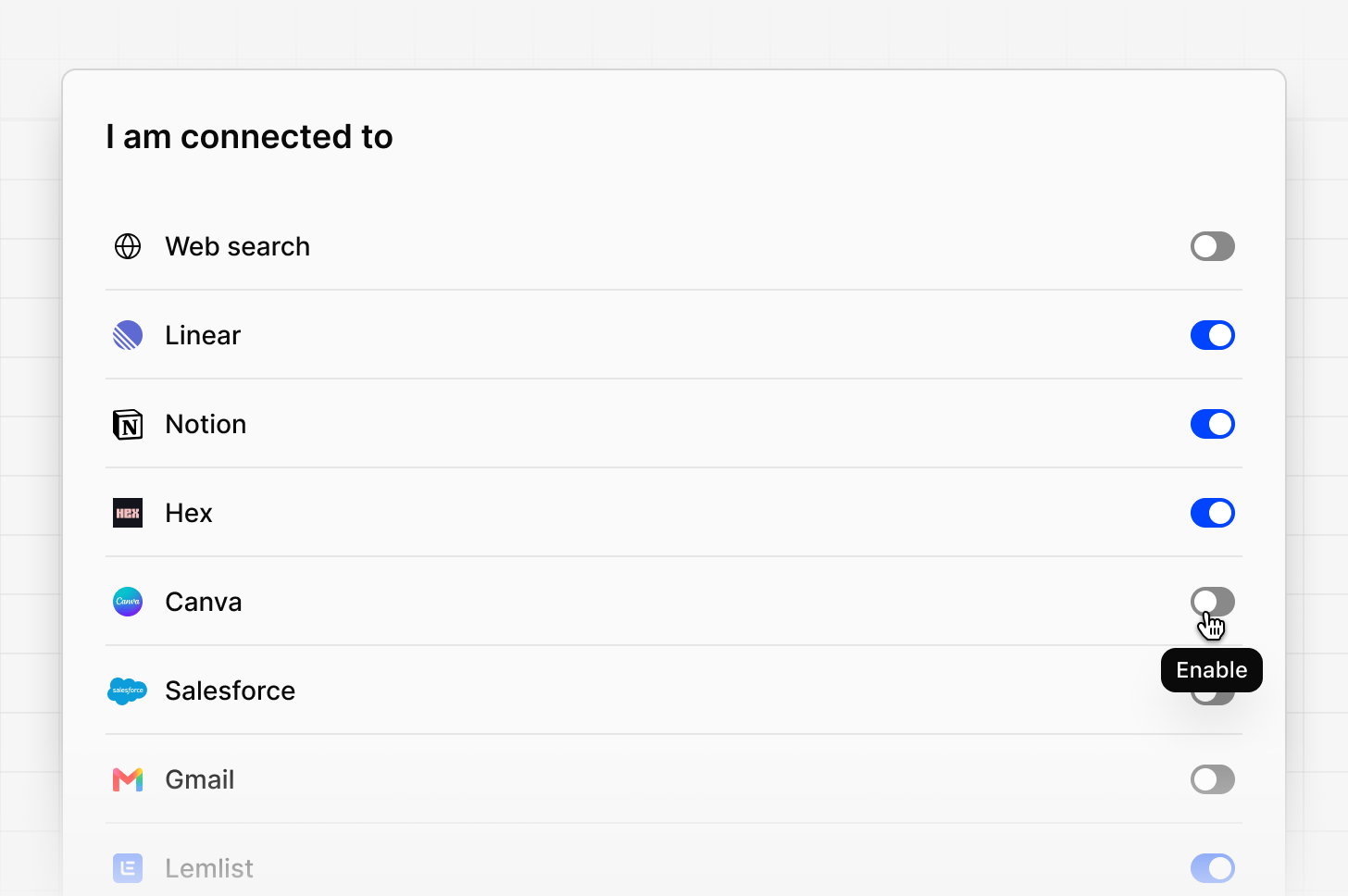
Web search
Toggle web search on to let your agent query the public web during a run. Useful when the agent needs current information that isn’t in your Dovetail workspace — competitor releases, industry benchmarks, or recent coverage tied to a trend in your data.Invoke agents in Chat
You can also work with agents directly from chat. Type @ followed by an agent’s name to mention it—this lets you run the agent on demand or ask it a question without leaving the conversation. If an agent is set up as a Digital Twin, click the Digital Twin icon in chat to enter that agent’s persona and interact with it continuously as a listener, rather than triggering a single run. Invoking an agent in Teams and Slack is coming soon.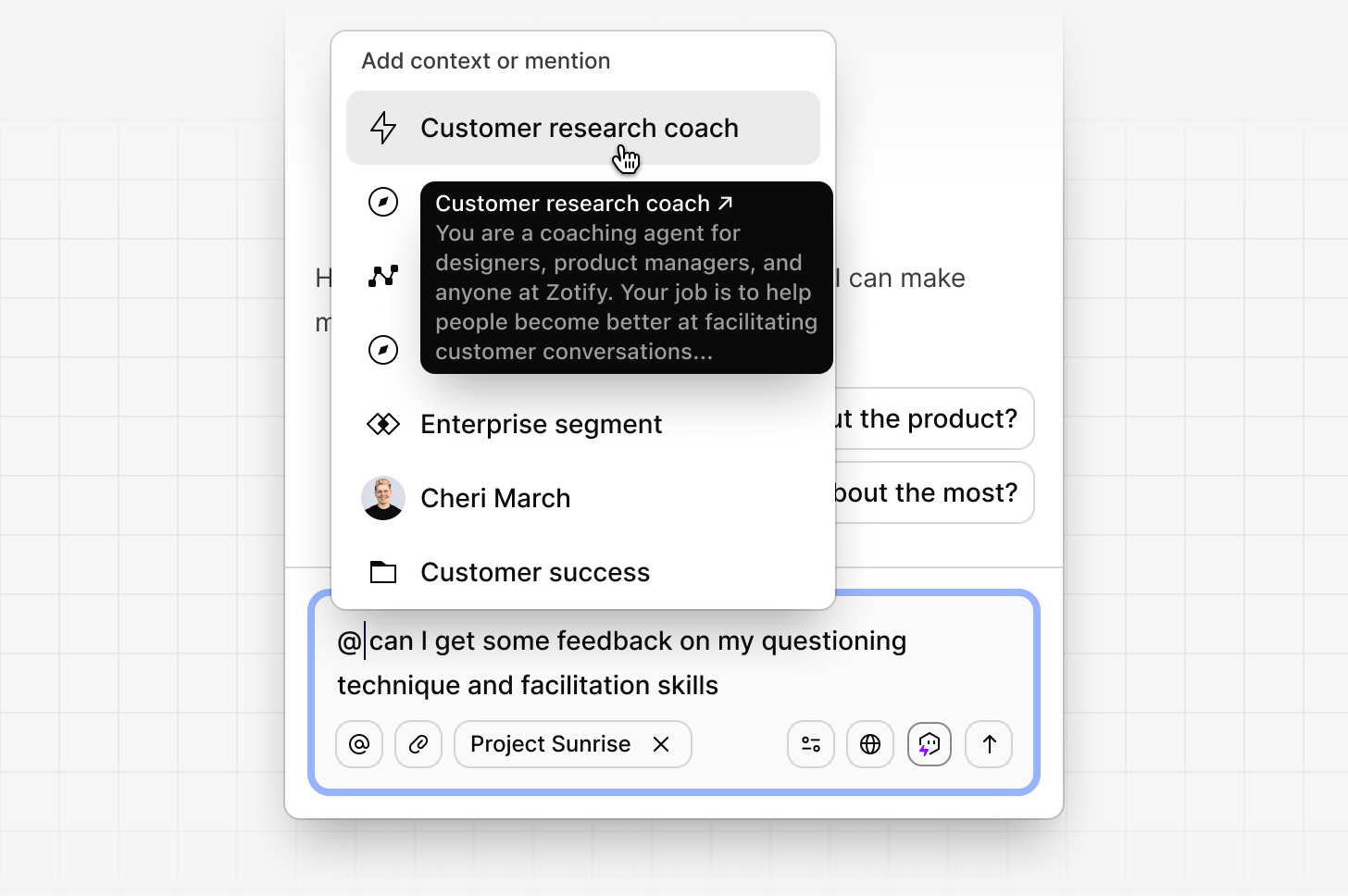
Sharing agents
Share an agent so teammates can run it in Chat or from the agent’s configuration page. Sharing controls who can invoke an agent—not who can change how it works.Who can do what
Editing an agent
Only the creator can change an agent’s instructions, memory, skills, triggers, connections, or tools. If a teammate needs changes, ask the creator to make them.Deleting an agent
Workspace admins can delete any agent in the workspace. Creators can also delete any agent they created.What View and Edit access mean
View and Edit access both allow a teammate to invoke and run the agent—in Chat or from the agent’s config page. Neither level lets a teammate modify the agent itself. Only the creator can do that.Agents are not available on free plans
FAQs
What happens when an agent's creator is deactivated or deleted?
What happens when an agent's creator is deactivated or deleted?
Workspace admins can delete the agent, but there is currently no option to transfer ownership of an existing agent to another user. If the agent needs to be recreated under a different owner, an admin can copy the agent’s prompt and configuration and create a new agent under an active user.
What can a Viewer do with an Agent?
What can a Viewer do with an Agent?
A viewer can do the following with an agent:
- Open and view an Agent
- Run an Agent (including chatting with it)
- Pin or unpin an Agent
- Share an Agent (if they have access)
- Send feedback
What can’t a Viewer do with an Agent?
What can’t a Viewer do with an Agent?
A viewer cannot do the following with an agent:
- Create a new Agent
- Edit an Agent’s setup (name, instructions, tools, skills, connectors, or when it runs)
- Move an Agent to a different folder
- Delete an Agent or move it to trash
Who can create and edit Agents?
Who can create and edit Agents?
Managers and Contributors can create Agents. Agents use the same access control system as projects, channels, and folders, so who can view or edit one follows the access set on it and on the folder it lives in. See Access and permissions. If you are on a plan that does not include roles, all users occupying a paid seat can create agents.
How do I pause a scheduled Agent?
How do I pause a scheduled Agent?
There’s no dedicated pause button. To stop an agent from running on its cadence, open the agent’s configure page, change Agent type from On schedule to On-demand, and save.This disables the schedule trigger. The agent itself isn’t deleted or affected in any other way — you can still run it manually at any time while it’s set to on-demand.
How do I resume a paused agent?
How do I resume a paused agent?
Switch Agent type back to On schedule and save. Your previous schedule pre-fills automatically, so you don’t need to recreate it.
Related guides
Agent workflows
Choose a trigger, write instructions, and test before launch.
Agent use cases
Ready-made agent prompts, grouped by role and team.