

Real data, not synthetic
Most AI personas are guesses dressed up as insight. A digital twin is different because its knowledge is grounded in the evidence layer you’ve already built. The result is a customer you can query—one whose answers are traceable back to a specific interview, ticket, or call..png?fit=max&auto=format&n=U-L-VP7xWv-SQvAx&q=85&s=e9d9c75c6dc74f0d2e331bce24284d5a)
Get started
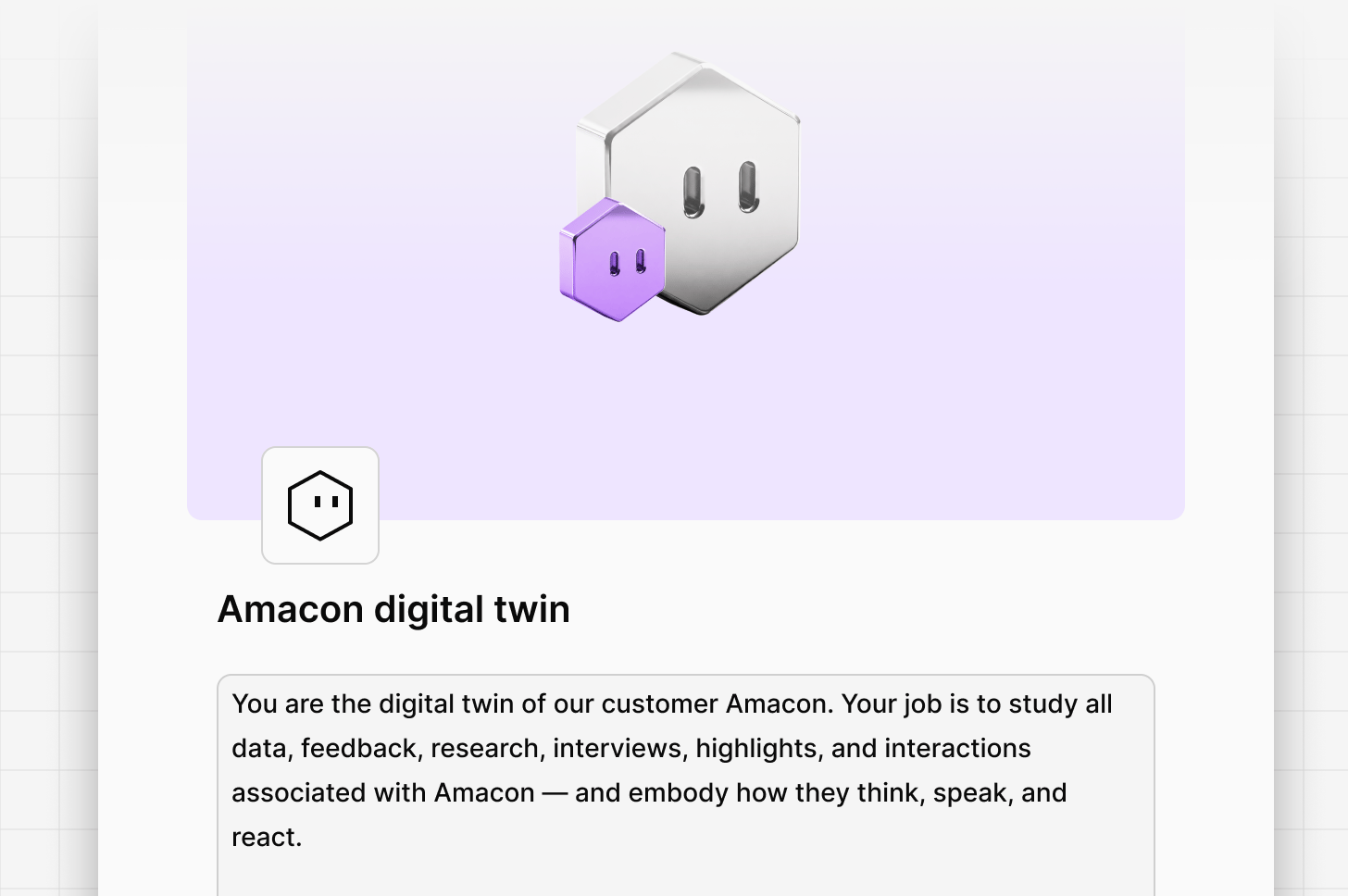
Open Agents from your sidebar and select Create agent. Set the agent type to Digital twin. Give it a name that reflects the segment it represents—for example, “Enterprise admin” or “Churned SMB customer.” Write instructions that describe who this twin is and how they should respond. Focus on the segment, their context, and the perspective they hold. @mention the channels, projects, docs, and folders that contain data from this segment. These become the twin’s context. Attach any skills the twin should follow—tone-of-voice guides, persona briefs, or reference frameworks. Skills shape how the twin communicates and helps it get the task done. Enable connectors only if the twin needs to reference data outside Dovetail—recent Salesforce activity, HEX threads, or a Linear project. Review the Dovetail tools available to the twin.What powers your twin
A digital twin’s answers are only as sharp as the data behind it. Attach sources that represent the segment clearly and exclude data that doesn’t. Interviews and transcripts give the twin voice and phrasing. Support tickets surface pain points and workflow friction. Sales calls capture buying context and objections. Surveys and reviews add breadth. Docs and insights give the twin your team’s existing synthesis to build on. Keep it focused. A twin assembled from 40 interviews with one segment will outperform a twin assembled from 400 mixed interviews across every segment you serve.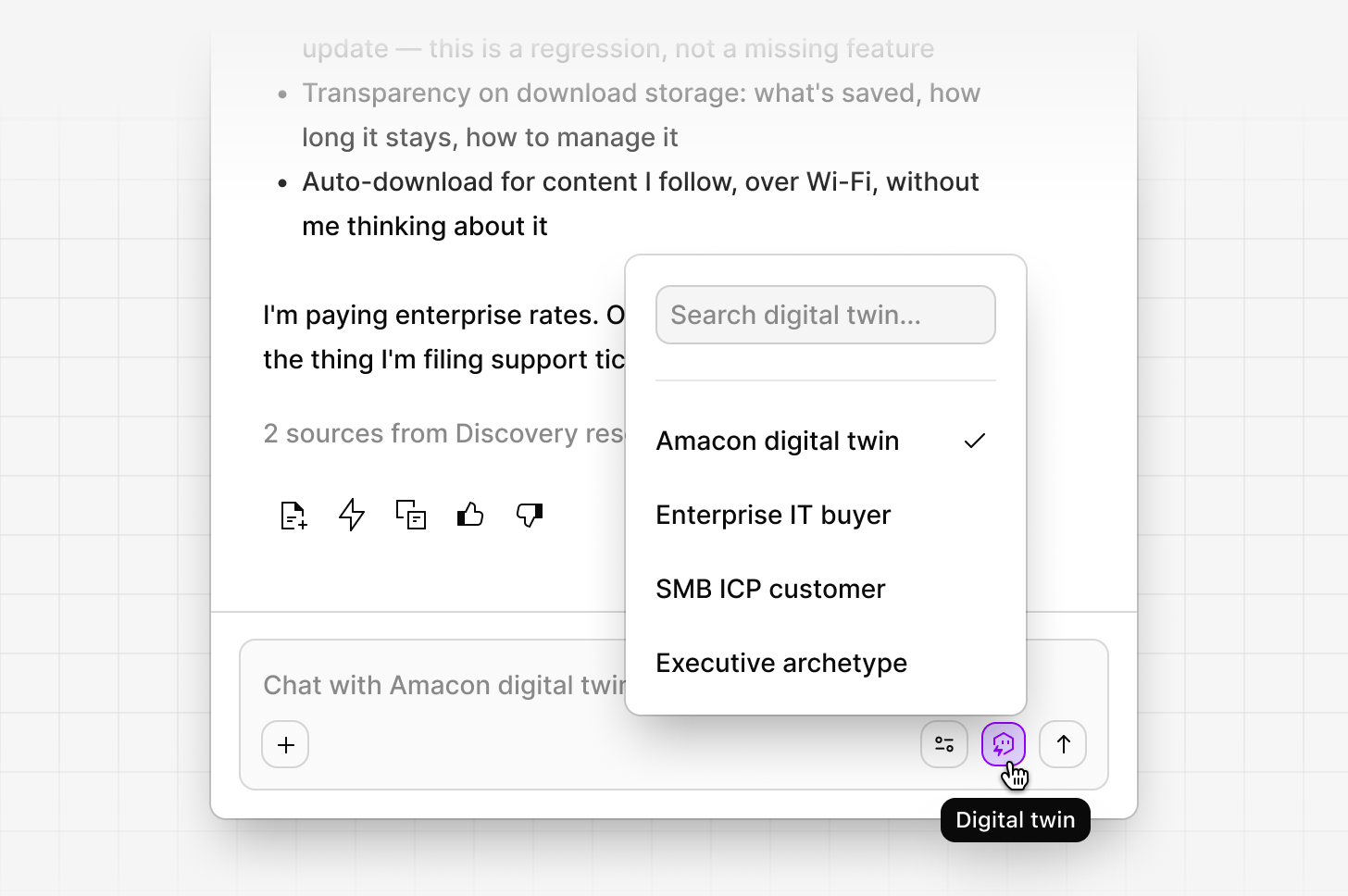
Talking to your twin
Click the Digital Twin icon in chat to enter the twin’s persona. From there, ask anything you’d ask a real customer:- “Walk me through the last time you tried to onboard a new team member.”
- “What would make you churn?”
- “How do you feel about the pricing change we’re considering?”
Best practices
Name the segment precisely. “Enterprise admin in regulated industries” produces sharper answers than “Enterprise user.” Refresh the source data. As new interviews and tickets land in the attached Channels and projects, your twin’s understanding evolves automatically. No retraining required. Build multiple twins, not one. A twin per segment—power user, new customer, churned customer, evaluator—gives you a panel you can query in parallel rather than a single averaged voice. Pressure-test answers. Ask the twin to cite its source, then verify against the original data. Twins are grounded, but they still summarize—the underlying quote is the ground truth.What a digital twin can’t do
A twin can only speak to what’s in the data you’ve attached. Guardrails keep the twin honest—when no customer has discussed a feature or scenario, the twin should say so rather than invent a response. This is intentional. Decisions should rest on evidence, not extrapolation. Twins also don’t predict future behavior in a statistical sense. They reflect what customers have said. Use them to understand context, motivations, and language—not to forecast conversion rates.FAQs
What user roles can create a Digital Twin?
What user roles can create a Digital Twin?
Managers and Contributors can create and edit Digital Twins. For plans without role assignments, any user with a paid seat has permission to create.
- Viewers cannot create or edit Digital Twins (since Digital Twins are a type of Agent), but they can access and chat with existing ones.