

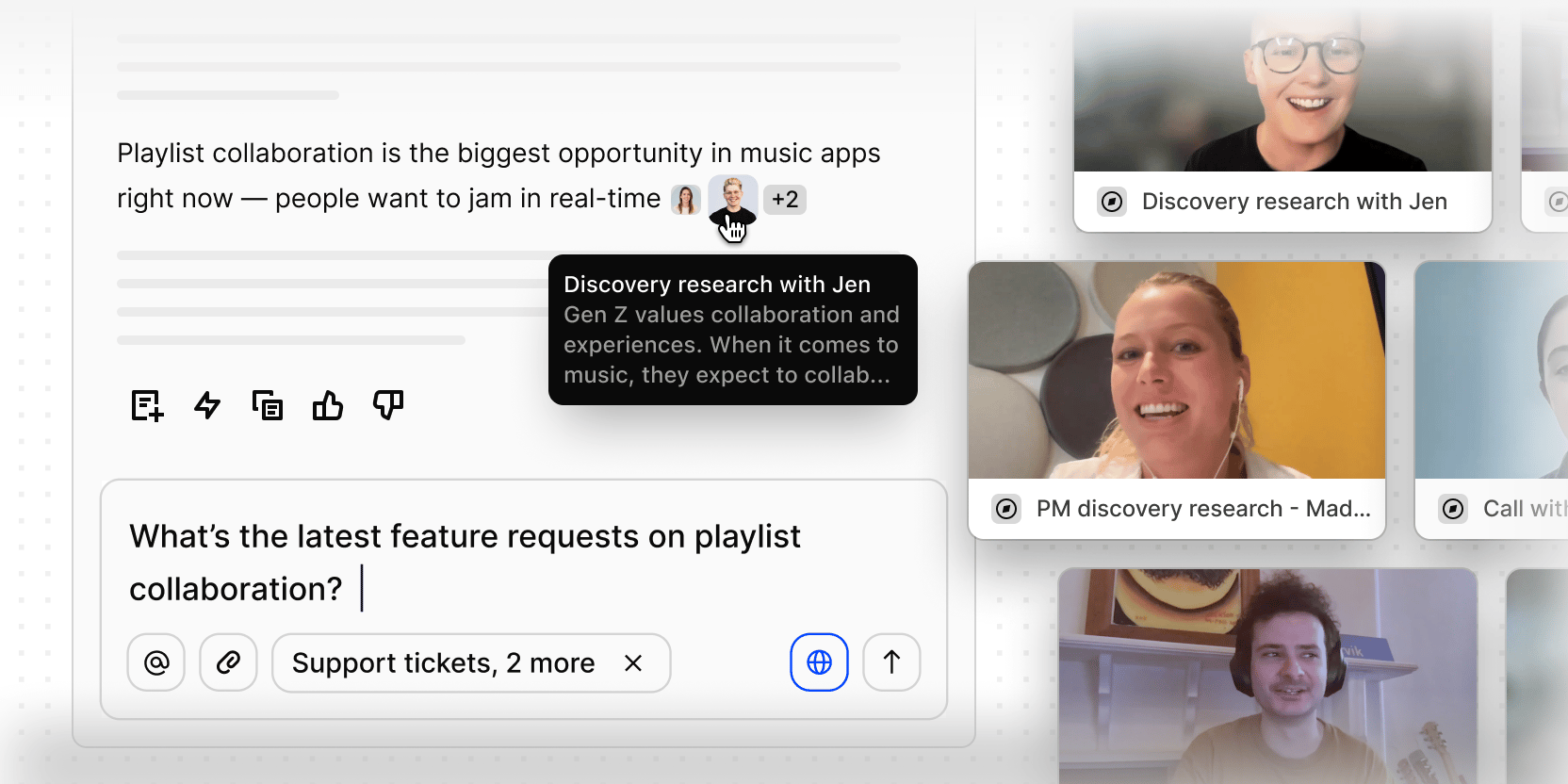
What is chat
Chat is a context-aware AI agent built into Dovetail. Ask a question, and it searches your workspace data, synthesizes an answer, and cites the sources behind it. Two things define how Chat behaves: where you open it (which determines what it searches) and what you ask (which determines how results are ranked and weighted).Where Chat gets its context
Every chat session draws from up to four layers of context, combined automatically:1. Workspace-level custom instructions
Admins can configure a global prompt (up to 50,000 characters) that prepends every AI interaction across the entire workspace — Chat, Agents, and Dovetail in Slack and Teams. Use it to set tone, restrict focus, or define a persona. It’s invisible to end users but shapes every response. (Admin only — configured in Workspace Settings → AI → Custom context)2. Location context
Where you open Chat determines what’s automatically loaded as starting context — before you ask anything.3. Workspace context docs
Admins can link existing docs — style guides, business context, persona overviews, product lines, strategy docs, product specs, research summaries, glossaries etc — to give the AI persistent, workspace-specific knowledge. Once linked, the content is processed and injected into the AI’s system prompt across every chat surface. For short content, the raw text is used as-is. For longer docs, the AI distills it into a concise summary so it fits cleanly into context without degrading response quality. Changes to linked docs are picked up automatically — you don’t need to re-link after editing. Examples of context that would drive better AI responses:- Company and product context — who you are, what you build, your market position, key terminology
- Strategy and priorities — company direction, OKRs, team goals, what’s in and out of scope
- Pricing and packaging — tier structures, plan names, feature availability by plan
- Customer and market context — your ICP, key segments, how you talk about your customers
- Product domain knowledge — how your product works, feature definitions, known limitations
- Brand and tone guidelines — so AI-drafted content matches your voice
- Research frameworks and templates — so AI-generated Docs follow your team’s structure
Note: Linked docs don’t need to be shared workspace-wide, but if a doc has restricted permissions, only users who have minimum viewer access to the doc will have it applied to their chat context.
4. Search results (per question)
Every question triggers a live hybrid search across the location’s scope. Results are ranked and injected into context automatically — you don’t see this happening, but it’s what powers the citations in responses.Search scope by location
The scope of each search is determined by where Chat is open. Opening Chat on a Project, for example, limits search to that project’s contents — it won’t pull in data from elsewhere in the workspace.
Tip: You can use @-mentions in any chat to bring a specific project, tag, channel, folder, doc, or data item into scope — even if it’s outside your current location.
How Chat weights and decides what’s relevant
Every question runs two searches in parallel, then combines the results:- Keyword search — finds documents that contain your exact words or phrases
- Semantic search — finds documents that match the meaning of your question, even if the exact words don’t appear
How titles and content are weighted
Not all text in a document carries equal weight. The principles are straightforward:How position within a document affects results
Within a single document, earlier passages rank higher than later ones. If your question matches content near the top of a data entry, that object will rank more strongly than one where the match is buried at the bottom.Recency
More recent documents rank higher when relevance is otherwise equal. If you have two data entries in a project that are equally on-topic, the newer one surfaces first. Older data doesn’t disappear — it just needs to be more relevant to compete.How the search comes together
- Two searches run in parallel — keyword (exact match) and semantic (meaning-based). Longer questions lean more heavily on semantic search; shorter ones balance both.
- Results are merged and deduplicated — if the same document shows up in both searches, it’s combined into a single result, not counted twice.
- Relevance and recency are combined — relevance carries more weight, with recency as a tiebreaker.
- Top results are injected as context — ranked highest to lowest, these become the sources Chat draws on to answer your question and generate citations.
What gets searched and how
Not all object types behave the same way in Chat. Some are directly searchable; some are used for filtering; some are only ever pre-loaded as context.Note on custom field filtering: Custom field filtering uses exact text matching — “APAC” matches “APAC,” not “Asia Pacific.” Date and number fields support range filtering. The top 30 values per field are included in context.
AI-generated Docs: Chat excludes AI-generated Docs from search results by default. Human-authored Docs are always included. The only exception: if you explicitly reference a specific AI Doc by ID in your question, that overrides the exclusion.
What Chat always excludes
- Archived and deleted documents
- Content you don’t have permission to access — Chat respects all existing permissions
- AI-generated Docs (unless explicitly referenced)
- Speaker names (stripped from transcripts before chunking)
- Custom fields with no values