

Overview
Bring your customer research into Microsoft 365 Copilot. Search your Dovetail workspace, pull docs and customer quotes, and ground your work in real research — whether you’re drafting a proposal in Word, building a business case in Excel, replying to a customer in Outlook, or answering a question in Teams, all without leaving Copilot.The Dovetail agent for Copilot is a first-party integration — no manual server configuration or API tokens needed. It uses OAuth, so you just sign in and authorize. The Dovetail agent is a connected app: each user adds it in Copilot and signs in with their own Dovetail account. Learn more about connected apps →
Supported capabilities
The agent has access to your full Dovetail workspace toolset. It can both read your research and, when you ask it to, create new content — write actions are always confirmed with you first.
Copilot always works within your existing Dovetail permissions — it can only see and act on what you already have access to. Before creating or changing anything, it tells you exactly what it will do and waits for your confirmation.
Connect Dovetail to Copilot
Before you connect you’ll need:- An active Dovetail account
- An active Microsoft 365 Copilot account
- Your Microsoft 365 admin may need to approve the Dovetail agent for your organization before it’s available for you
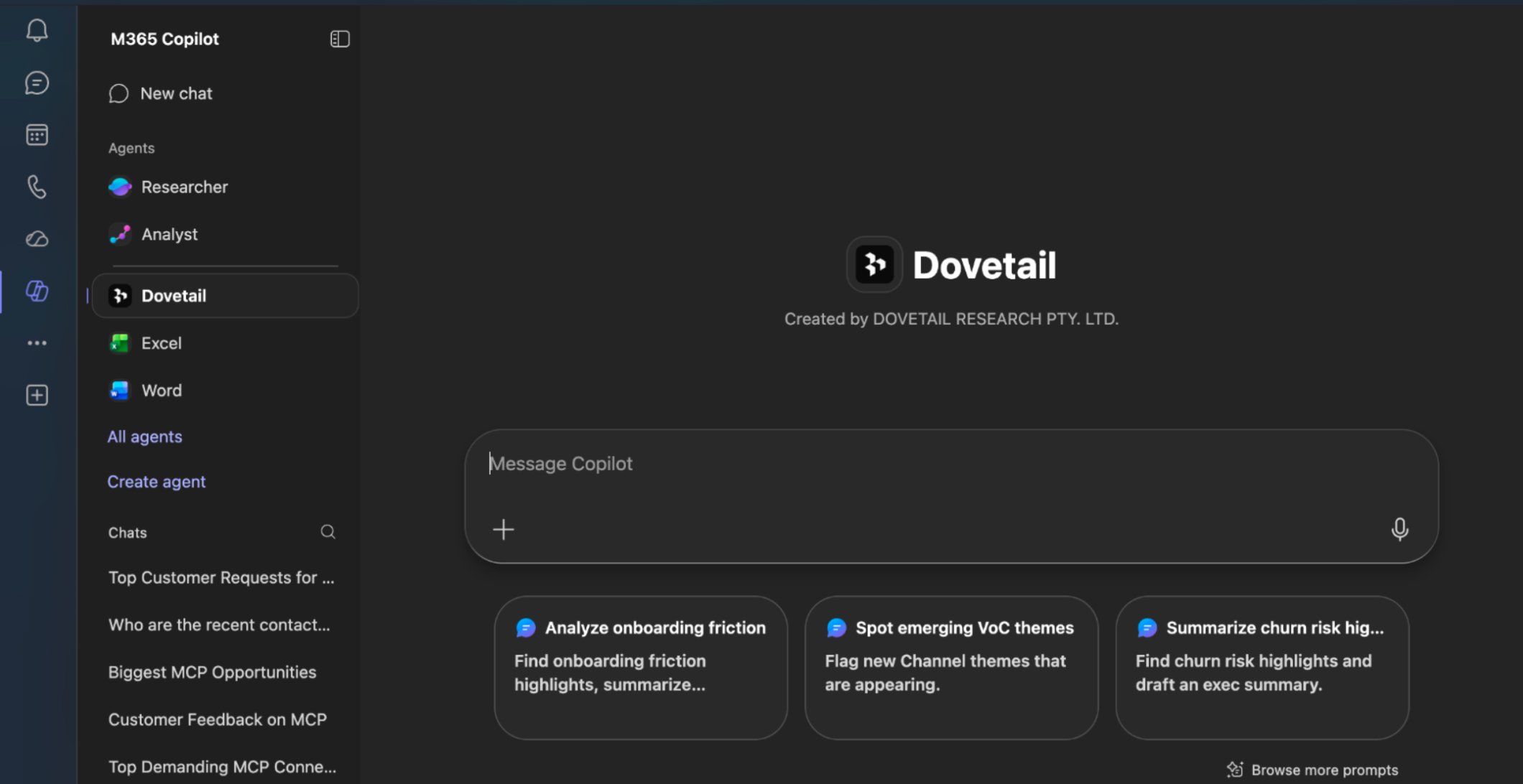
- Add the Dovetail agent. In Microsoft 365 Copilot, open the agents panel and choose Get agents (or, in Microsoft Teams, go to Apps). Search for Dovetail and add it. If you already use Teams, the agent is quick to add from there.
- Sign in to Dovetail. Open the Dovetail agent and start a chat. The first time you use it, Copilot prompts you to connect — select Sign in, then authorize access with your usual Dovetail credentials.
- Start asking questions. Copilot can now search your workspace, read docs, and surface customer highlights — and use that research as grounded evidence in whatever you’re writing.
Enable. This opens the Dovetail agent’s page in Microsoft 365 Copilot in a new tab, where you can add the agent.
Using Dovetail in your prompts
Once connected, open a chat with the Dovetail agent in Microsoft 365 Copilot and ask in natural language. The best results come from letting Copilot chain tools together — search first, read the details, then draft.Example: prepare for renewal conversations
Example: find product gaps
Example: spot emerging themes
Tips
Start with search
Start with search
If you’re unsure of a project name, ask Copilot to list your projects first, or paste a Dovetail URL and it will resolve it to the right project, doc, or highlight.
Combine tools in one conversation
Combine tools in one conversation
For the best results, ask Copilot to chain actions together, such as “Search for X, read the full doc, then pull the supporting quotes.”
Read the content
Read the content
“Get” often returns metadata only, so ask Copilot to read or summarize a doc or transcript to fetch the full content before answering.
Review before creating
Review before creating
Copilot can create projects, docs, data entries, highlights, and channel feedback, and it will always ask for confirmation before making changes.
Fetch more results
Fetch more results
Results are returned in batches, so ask Copilot to “get the next page” to continue browsing large projects or channels.